
Tax-Free Trading at Your Fingertips
Spread betting represents a low-cost way to trade, deploying inherent leverage and low trading costs to provide a more efficient way of trading in shares, commodities, currencies, indices, and a variety of other markets absolutely tax-free.

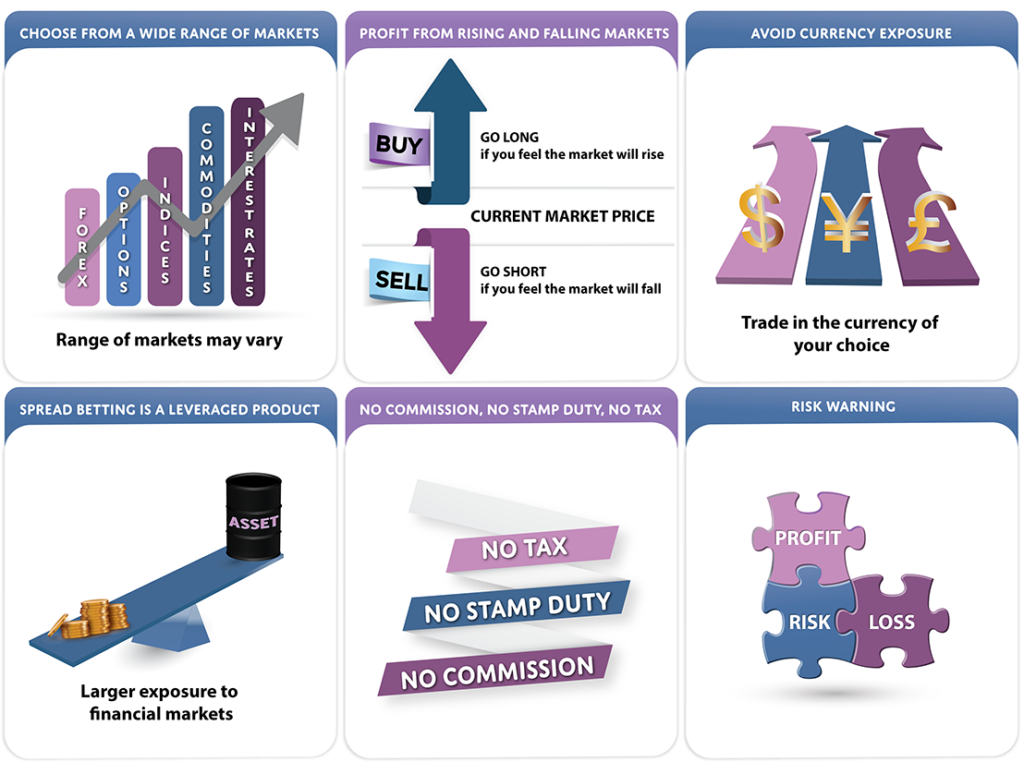
 Spread betting is a derivative product which allows traders of all walks of life to speculate on and profit from rising and falling markets in a cost-efficient way. Since it’s a leveraged product, traders only need a fraction of the capital to take bigger positions and benefit from its tax-free status.

Spread betting is a low-cost leveraged product allowing traders to benefit from rising and falling markets.

What you need to know before placing your first spread bet, and how to make your experience effortless.

Explore the basics of spread betting, key concepts and terms, and how retail traders can benefit from it.

Spread Betting at a Glance
Read more: spread betting advantages
Choosing the Right Account

How Is Spread Betting Different?
Trading Markets Directly (Owning the Asset)
When a trader invests in the stock market, they buy shares in one or a number of listed companies, having reasoned that external market factors combined with business strategy are likely to lead to an increase in value over time. This increase in value, combined with an ongoing dividend to reflect the trader’s share of the company’s ownership is where the money in stocks and shares is to be made, and the security of a tangible, valuable asset in the form of a share is sufficient to slim down the risk profile.
Trading Markets Through Spread Betting (Speculating on Price Movements)
Spread betting, on the other hand, operates on an entirely different principle. While to think of spread betting as gambling isn’t always helpful, it is perhaps a valuable lens through which to analyse the theoretical structure of what spread betting is and how it works. With spread betting, the transaction being entered into when you trade on a company’s shares is not a share transaction. There is no transaction per se, and no change of ownership of any tangible asset – simply an agreement between trader and broker to enter into a wager on set terms, based on the outcome of some underlying market.
As such, spread betting can be equally deployed as a mechanism for speculating on financial markets, sports or just about anything that can be measured – for the operation of the spread betting model, there is no need for anything financial or economic, nor even for anything predictable or controllable.
| Features | Spread Betting | CFDs | Share Trading |
|---|---|---|---|
| Tax | No Capital Gains Tax, no income tax, no stamp duty | Subject to CGT, no stamp duty | Subject to CGT and stamp duty |
| Go Long/Short | Yes | Yes | Buy only |
| Leveraged | Yes | Yes | No |
| Commission | No | Yes | Yes |
| Good for Long-Term? | No | No | Yes |
| Markets | Wide range of markets | Wide range of markets | Shares only |
| Currency | GBP (or currency of your choice £/$/€) | Currency of the underlying asset | Currency of the shares |
| Regional Availability | UK and Ireland | Global (restrictions apply) | Global (restrictions apply) |

Are you sure spread betting is the right product for you? Check if CFDs are a better option for your needs.

Leverage is an integral part of spread betting, and it’s vital that traders understand how to use it correctly.

Even though spread betting might seem like an easy trading instrument, make sure you understand the risks.
Get Access to Over 1,000 Markets

Forex
Market
Spread Betting Forex

Shares
Market
Spread Betting Shares

Indices
Market
Spread Betting Indices

Commodities
Market
Spread Betting Commodities

Cryptocurrencies