
StarTrader is one of those brokers that quietly ticks more boxes than you might expect. Founded in 2011 and now licensed in multiple regions, it has steadily built a global presence while offering a product set that caters to both beginners and experienced traders. StarTrader looks like it’s trying to strike the right balance between accessibility and performance.

Only Trade with Regulated and Reputable Brokers

Compare Regulated Forex Brokers Compare Regulated CFD Brokers

StarTrader Information

  • Regulations: ASIC (Australia), FSCA (South Africa), FSA, CMA, SVGFSA

  • Trading Instruments: Forex, CFDs

  • Range of Markets: Forex, Indices, Commodities, Stocks, ETFs

  • Trading Platforms: MT4, MT5, Web Trader

  • Key Features: High Leverage, Copy Trading, PAMM Accounts

What StarTrader Has to Offer

At first glance, StarTrader doesn’t rely on flashy marketing or exaggerated claims. Instead, it delivers a clean interface, well-supported platforms like MT4 and MT5, and an account structure that’s flexible enough for different trading styles. The broker offers access to a wide variety of instruments, from forex and indices to metals and stocks, all delivered through familiar, stable platforms.

While not quite a household name, StarTrader is clearly positioning itself as a serious option for those who want decent pricing, a strong feature set, and reliable execution – all backed by regulatory oversight in several regions. It’s not perfect, but there’s enough here to take a closer look.
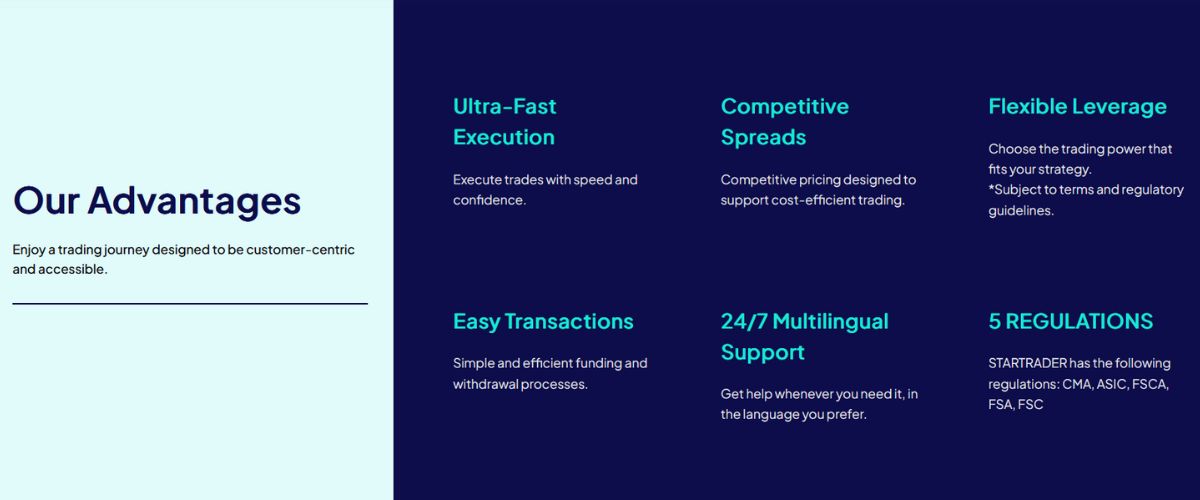
What StarTrader has to offer - features, promises, advantages

Regulation and Security

StarTrader’s regulatory profile is one of its stronger points – especially for traders who want peace of mind without being locked into restrictive jurisdictions. The broker is authorised by several regulators, including:

  • The Australian Securities and Investments Commission (ASIC), known for enforcing high standards of conduct and capital requirements.
  • South Africa’s Financial Sector Conduct Authority (FSCA), which brings regional credibility and a growing reputation among retail traders.
  • Capital Markets Authority (CMA) in Kenya, adding localised oversight in Africa.
  • Seychelles Financial Services Authority (FSA) – a more flexible offshore regulator, but still a step above brokers operating without any oversight at all.
  • SVGFSA (Saint Vincent and the Grenadines) – often used for registration but provides no real regulatory supervision.

So while it’s not regulated in the EU or UK, StarTrader still holds several active licenses and doesn’t operate as a typical offshore-only broker. Client fund protection varies by region, and there’s no investor compensation scheme under these regulators, but the multi-jurisdiction structure does lend the broker more credibility than most in its category.

Trading Platforms

StarTrader offers a clean, reliable platform lineup that caters to most trading styles without overcomplicating things. Traders have access to three core platforms, each with its strengths:
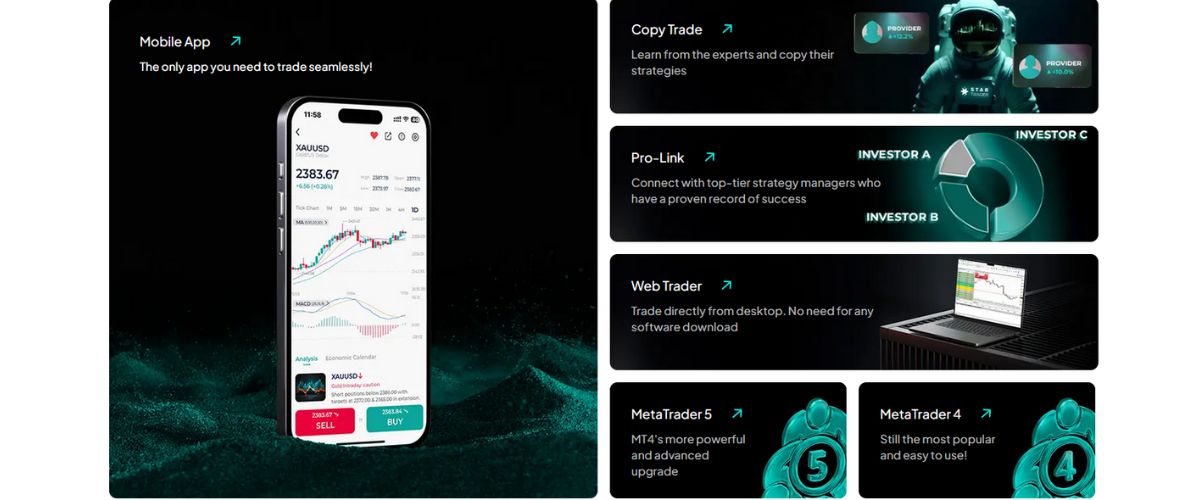
  • MetaTrader 4 (MT4): A long-time favourite among forex traders. Known for its stability, fast execution, and wide range of custom indicators. MT4 remains a solid choice for discretionary and automated traders alike.

  • MetaTrader 5 (MT5): A more modern platform that builds on MT4’s foundation. It includes additional charting tools, more time-frames, an integrated economic calendar, and enhanced order management. A good fit for those trading multiple asset classes.

  • Web Trader: A browser-based platform that requires no download. It offers much of the same functionality as the desktop versions, including real-time quotes, charting tools, and one-click trading. Ideal for those who need flexibility or trade on the go.

A list of platforms offered by StarTrader

Execution across platforms is smooth, with no major issues reported. The mobile apps for MT4 and MT5 are also available, giving traders full control from anywhere.

In terms of trading tools, StarTrader offers VPS hosting for algorithmic traders who rely on Expert Advisors and need uninterrupted uptime. There’s also access to Trading Central, which delivers technical analysis, trade ideas, and market commentary – useful for those who appreciate a second opinion before pulling the trigger.

It’s a practical setup. No gimmicks, just platforms and tools that actually help you trade.

Account Types

StarTrader offers three core account types, each designed to meet the needs of different trading styles and levels of experience. The structure is clean and easy to understand, with a low entry point that makes it accessible to most traders.

  • Standard Account: This is the most beginner-friendly option. It features spreads starting from 1.3 pips with zero commission per trade. It’s designed for those who want simplicity and transparency, especially if you’re not placing high-frequency trades.

  • ECN Account: Aimed at more active traders, the ECN Account provides access to raw spreads starting from 0.0 pips. In return, there’s a $7 commission per round-turn. This setup suits scalpers, day traders, or anyone who prioritises tighter pricing.

  • Prime ECN Account: This is StarTrader’s premium-tier offering, designed for high-volume or professional traders. It also features raw spreads from 0.0 pips but lowers the commission to $4 per round-turn. The minimum deposit requirement is higher at $10,000, clearly targeting serious traders or institutional-level clients who demand top-tier pricing and execution.

In addition to these, StarTrader also provides a swap-free (Islamic) account option for clients who require interest-free trading in line with religious principles. This can be requested at the time of account opening or added later.

Markets and Instruments

StarTrader delivers a focused yet diverse portfolio of tradable assets, offering everything most retail and even experienced traders might look for. Rather than padding its offering with obscure markets, it covers the essentials, and does so with precision.

  • Forex: With over 50+ currency pairs, StarTrader provides a broad mix of majors, minors, and exotics. Spreads are competitive, and execution is generally smooth, especially on the ECN and Prime ECN accounts. Whether you’re scalping short-term moves or holding swing positions, the forex coverage here ticks all the important boxes.

  • Shares (CFDs): You’ll find 700+ stock CFDs, mainly covering US, UK, and EU-listed companies. This is ideal for traders looking to speculate on earnings reports, corporate news, or market trends without having to own the underlying shares. It’s a respectable number, and while you won’t get every niche stock, the most actively traded names are all there.

  • Commodities: StarTrader offers 10+ commodities, including gold, silver, oil, and natural gas. These assets can serve as hedging instruments or be traded outright, and they come with reasonable margin requirements. While the selection isn’t huge, it includes the key benchmarks that matter to most commodity traders.

  • Indices: The broker covers 20+ global indices, including household names like the S&P 500, NASDAQ, FTSE 100, DAX, and others. These allow traders to capture broader market sentiment, or trade economic events without diving into single stocks.

  • Others: A small selection of ETFs and futures round out the offering, though these aren’t the platform’s primary focus. They’re more supplemental than core instruments, but a nice addition for those who want to diversify even further.

In total, StarTrader offers access to hundreds of instruments across all categories. It’s not the most extensive product list on the market, but it’s certainly more than enough for serious traders – and without the clutter. The broker clearly focuses on the most traded markets, which helps keep execution clean and spreads tight where it counts.

Fees and Spreads

StarTrader keeps its pricing competitive across the board. On the Standard Account, spreads start from around 1.3 pips, with no commissions, making it a simple option for beginners. The ECN Account and Prime ECN Account offer raw spreads from 0.0 pips, with commissions of $6 and $3 per round-turn, ideal for active traders seeking tighter pricing.

Leverage goes up to 1:500, depending on the asset, with forex offering the highest levels. While high leverage can boost exposure, it also increases risk, so a disciplined approach is essential. Negative balance protection is included.

There are no deposit or withdrawal fees on StarTrader’s side, which is a welcome plus. Swap rates and overnight charges are transparently listed in the trading platform.

Customer Support and Education

Customer service is available via live chat, email, and phone. Support is said to be 24/5, but response times vary. Some traders have reported fast help, while others struggled to get answers to more technical queries.

As for educational material, StarTrader’s content is thin. You’ll find a basic glossary, a few articles about market movements, and a short FAQ section, but not much else. There are no structured courses, strategy videos, or interactive webinars, which makes it less appealing for beginners who need more hand-holding.

StarTrader Pros and Cons

Pros

  • Well-regulated in multiple regions: StarTrader is licensed by several financial authorities, including South Africa’s FSCA, Australia’s ASIC, and the Seychelles FSA. While not regulated in Europe, this multi-jurisdictional setup still provides a decent layer of credibility and operational oversight.

  • Competitive trading conditions: Tight spreads, high leverage options, and zero-commission trading on certain accounts give traders flexibility when it comes to managing costs and strategies. This is especially appealing to scalpers and short-term traders.

  • Choice of account types: With three clearly defined account types – Standard, ECN, and Prime ECN – traders can align their account with their level of experience, trading volume, and pricing preference. Each comes with its own balance of spreads, commissions, and minimum deposit.

  • Multiple platforms: StarTrader supports both MetaTrader platforms and a browser-based WebTrader, allowing for flexible access across desktop and mobile without compromising core functionality.

  • Promotions and bonuses available: The broker frequently runs various promotions, including deposit bonuses and trading contests. While these always come with terms and conditions, they can offer added value for those who trade actively and meet the eligibility criteria.

Cons

  • No tier-1 European regulation: Although licensed in multiple jurisdictions, StarTrader lacks oversight from top-tier European regulators like the FCA or CySEC. This may be a sticking point for traders who place a high value on regulatory protection and compensation schemes.

  • Limited educational support: There’s no real structured education to speak of, no in-depth courses, webinars, or trading mentorship. Beginners may find the learning curve steeper here without guidance built into the platform.

  • Not as many markets as top-tier competitors: While StarTrader covers the essentials, it doesn’t offer the same sheer volume of tradable assets that some larger brokers do. There’s no access to ETFs, bonds, or more exotic instruments, which could be a drawback for traders looking to branch out.

  • Still relatively unknown: StarTrader doesn’t yet have the global recognition of more established brokers. There’s limited long-term user feedback and fewer online discussions, which can make it harder to judge reliability purely from community experience.

StarTrader Reviews from the Web

User feedback across online forums and platforms like TrustPilot is mixed. Some traders appreciate the simplicity of signing up and the availability of MetaTrader platforms. A few have noted tight spreads and quick funding times.

StarTrader Trustpilot reviews

However, others have raised concerns about withdrawal delays, lack of transparency on fees, and poor customer support. A common thread is that while things start smoothly, problems arise when users try to withdraw larger profits or close accounts.

As with many brokers, reviews appear polarised, and this inconsistency is something traders should keep in mind.

StarTrader FAQs

Yes, StarTrader is regulated by several financial authorities, including the FSCA in South Africa, ASIC in Australia, the FSA in Seychelles, and others. However, it’s worth noting that the broker doesn’t hold any licenses from top-tier European regulators such as the FCA or CySEC, which may be a deciding factor for some clients based in Europe or those prioritising maximum protection.

Traders can choose between MetaTrader 4 (MT4), MetaTrader 5 (MT5), and a browser-based WebTrader. MT4 remains a favourite for forex traders due to its stability and simplicity, while MT5 brings more features and better support for other asset classes. WebTrader is useful for quick access without software installation.

StarTrader doesn’t specify a fixed minimum deposit for its Standard and ECN accounts, which might depend on your chosen payment method or local region. However, if you’re considering the Prime ECN account, be prepared – the minimum deposit is set at $10,000. It’s clearly a product geared more toward high-volume or professional traders.

StarTrader does not charge internal withdrawal fees, though third-party providers may apply their own charges depending on the method used. Withdrawal times typically vary between 1–3 business days. It’s always a good idea to double-check what fees might be involved on the payment provider’s side.

Leverage at StarTrader can go up to 1:500 depending on your account type and the asset being traded. This high leverage is attractive for traders looking to maximise exposure with less capital, but it also increases the risk. Beginners should be especially cautious and fully understand how leverage works before using it.

Yes, StarTrader does offer swap-free accounts that comply with Islamic finance principles. These accounts are interest-free and allow traders to hold positions overnight without paying or receiving rollover fees, although certain conditions and restrictions may apply.

No, StarTrader does not currently offer cryptocurrency trading. Their focus is on more traditional markets such as forex, stocks, indices, and commodities. If crypto exposure is a key part of your strategy, you may need to consider a different broker that supports digital assets.

StarTrader: What You Need to Know

StarTrader positions itself as a serious contender in the online trading space, backed by multiple regulatory licenses and a clean, professional setup. Its support for MT4, MT5, and WebTrader offers enough flexibility for most traders, and multiple deposit options make it easy to test the waters without over-committing.

Spreads are competitive, execution is smooth, and their tiered account structure offers decent variety depending on how hands-on or cost-sensitive you want to be. On top of that, ongoing promotions and a transparent pricing model add to the broker’s appeal.

That said, StarTrader is not perfect. It lacks regulation in Europe, doesn’t support crypto trading, and doesn’t offer quite the same breadth of instruments as some of the larger, more established brokers. The educational section is also underwhelming if you’re just starting out and looking for structured learning.

Overall, StarTrader is a good choice for traders who already know what they want, especially if regulation outside the EU isn’t a deal-breaker. For beginners or those looking for crypto and a broader asset range, there might be better alternatives. Still, as a no-fuss, cost-effective platform, StarTrader delivers where it matters.