
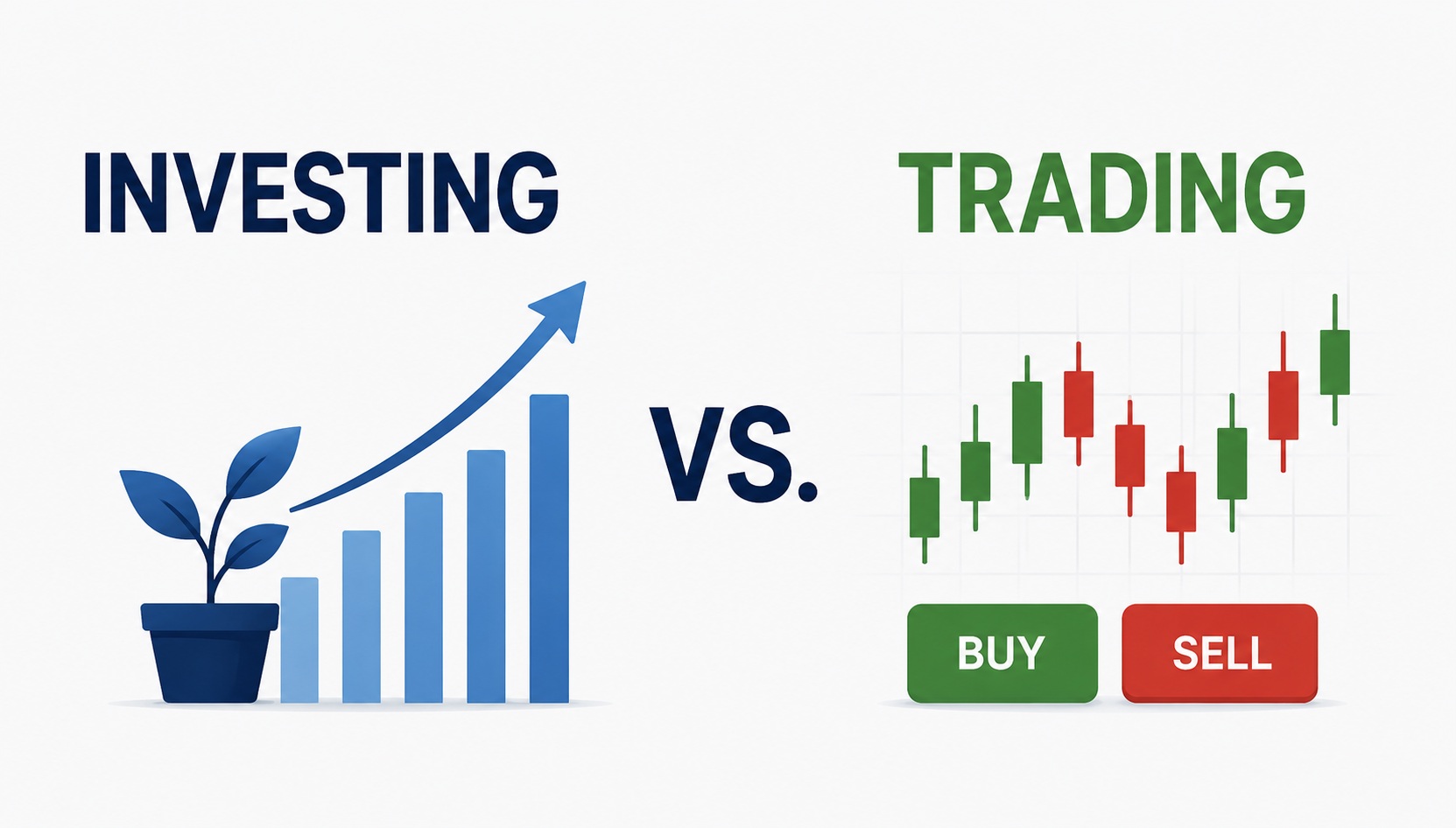
Investing and trading both involve putting money into financial markets, but they are not the same thing.
The main differences come down to time, objectives and how decisions are made. An investor may buy shares and hold them for ten years. A trader could buy and sell the same shares within a day.
Risk also looks different. Investors are generally more concerned with the long term value of an asset, while traders tend to focus on shorter term price movements.
Neither approach guarantees a return, and both can result in losses. Understanding how they differ is therefore a sensible starting point.
What Is Investing?
Investing generally means buying an asset with the intention of holding it for the medium to long term.
An investor buying shares is purchasing an ownership interest in a company. Their decision might be based on the company’s profits, financial position, competitive advantages, dividend record and prospects for future growth.
The important point is time.
An investor is normally less concerned about what happens to the share price tomorrow than where the company might be in five or ten years.
Typical investments include:
Some investments may also generate income through dividends or interest.
A Simple Investing Example
Suppose an investor researches a large listed company and believes it has strong finances and reasonable long term prospects.
They buy 100 shares.
The share price subsequently falls by 5% during a difficult month for the stock market. The investor may decide to continue holding because nothing fundamental has changed about the business.
Of course, their original assessment could still be wrong. Investing for longer does not guarantee a profit.
What Is Trading?
Trading is generally more concerned with movements in market prices over shorter periods.
A trader may hold a position for weeks, days, hours or even minutes. Rather than asking where a company could be in ten years, they might be interested in what its share price will do following tomorrow’s results.
This creates a different decision making process.
Traders frequently look at:
Some traders also use fundamental analysis. The difference is that the information is generally being used to make a shorter term decision.
Typical trading instruments include shares, forex, CFDs, futures, options, commodities and indices.
Not every instrument is available to every retail trader, and regulatory rules vary considerably between products and jurisdictions.
Investing vs. Trading: Time Horizons
Time is probably the easiest difference to understand.
Investors generally think in years. Traders often think in weeks, days or hours.
A long term investor buying shares in a supermarket might be interested in revenue growth, margins, debt and dividends.
A trader looking at the same supermarket could be interested in an earnings announcement due on Thursday morning.
Both are looking at the same company. They are simply asking different questions.
Long term investing also tends to involve fewer transactions. A portfolio might remain largely unchanged for months.
Active traders can make considerably more transactions, which means trading costs deserve greater attention.
Small costs have a habit of becoming less small when they are repeated hundreds of times.
How Risk Differs
Investing is sometimes described as safer than trading, but this is too simplistic.
Investors still face substantial risks.
Companies can fail. Share prices can fall dramatically. Economic conditions change, and entire markets can remain depressed for extended periods.
Diversification can reduce dependence on a single company or market, but it cannot eliminate risk.
Trading introduces additional considerations.
Short term prices can be extremely volatile. Frequent decisions also create more opportunities to make mistakes.
The risks become particularly important when leverage is involved.
CFDs, for example, allow traders to gain market exposure by depositing only a proportion of the total position value as margin. Profits and losses are still calculated using the full position.
A relatively small market movement can therefore have a significant effect on the trading account.
Decision Making
Investors generally concentrate more heavily on fundamental value.
They might ask:
Traders tend to concentrate more heavily on price and timing.
They might ask whether a market is trending, where support and resistance levels sit, whether volatility is increasing and where a position should be closed if the original idea proves incorrect.
Neither approach removes uncertainty.
Fundamental analysis cannot tell an investor exactly what a share will be worth in five years. Technical analysis cannot tell a trader exactly where the market will be tomorrow.
Analysis provides information. It does not provide certainty.
Different Approaches to Risk Management
Investors and traders also tend to manage risk differently.
Long term investors often use diversification. Instead of putting all their capital into one company, they may spread investments across different businesses, sectors, countries and asset classes.
Asset allocation can therefore form an important part of investment risk management.
Traders generally need to think more about individual position risk.
This can include position sizing, stop losses, overall market exposure and the amount of capital being risked on each trade.
A trader using leverage needs to be particularly careful.
More leverage provides greater exposure to market movements, but it works in both directions. Increasing leverage does not improve the quality of a trading decision.
Psychology and Behaviour
The psychological demands of investing and trading are also different.
Investors need patience.
A good investment can fall in value. Markets go through corrections and bear markets, while individual companies inevitably experience difficult periods.
The challenge is deciding whether a falling price represents a temporary problem or evidence that the original investment case was wrong.
Traders face more immediate pressure.
A position can move against them seconds after it is opened. This creates temptation to close trades too early, hold losses for too long or increase the size of the next position in an attempt to recover money.
Good trading therefore requires discipline.
A particularly dangerous habit is turning an unsuccessful short term trade into a supposed long term investment simply because the trader does not want to close it.
The original reason for opening the position still matters.
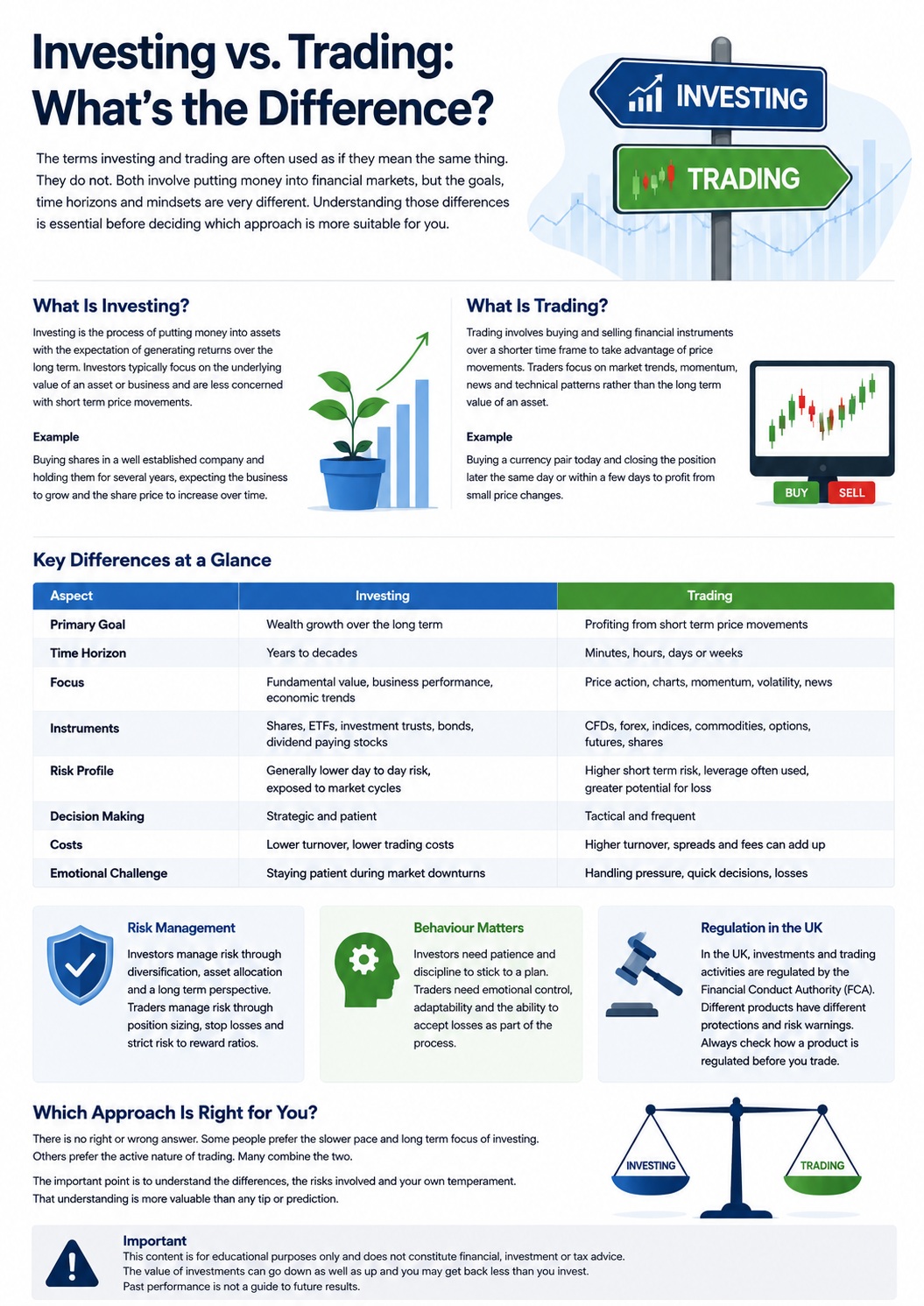
Investing vs. Trading at a Glance
| Factor | Investing | Trading |
|---|---|---|
| Main goal | Long term growth or income | Benefit from shorter term price movements |
| Time horizon | Usually years | Minutes, days, weeks or months |
| Decision making | More strategic | More tactical |
| Main analysis | Fundamentals and valuation | Price, charts, volatility and market events |
| Typical instruments | Shares, funds, ETFs and bonds | Shares, CFDs, forex, futures and options |
| Transaction frequency | Usually lower | Usually higher |
| Use of leverage | Less common | More common |
| Risk management | Diversification and asset allocation | Position sizing, stops and exposure limits |
| Direct Market Access (DMA) | Yes (not all brokers offer DMA) | No |
| Charges | Commission (or wider spread depending on account type) | No commission, only spread |
| Psychological challenge | Patience | Discipline and emotional control |
What About Costs?
Costs matter in both cases, although they can affect investors and traders differently.
An investor who buys a diversified fund and holds it for years may make relatively few transactions. Fund charges, platform fees and dealing costs can still reduce returns over time.
Active traders face a different problem.
Spreads, commissions and other transaction costs can accumulate because positions are opened and closed more frequently. Traders using leveraged products may also face overnight financing charges when positions remain open.
The cheapest provider is not necessarily the best, but costs should always be understood before investing or trading.
Regulation and UK Investors
Regulation is another area where the distinction becomes important.
Financial products available to UK retail clients are subject to different rules depending on their structure.
CFDs are a good example.
The Financial Conduct Authority places restrictions on CFDs offered to retail clients, including leverage limits, margin close out requirements, negative balance protection and standardised risk warnings.
Buying ordinary shares is fundamentally different. The investor owns the shares rather than entering into a leveraged derivative contract based on their price.
Investors and traders should therefore understand exactly what product they are using and check that the provider is appropriately authorised.
The FCA register can be used to verify whether a financial services company is authorised and what activities it has permission to conduct.
Can You Invest and Trade at the Same Time?
Yes.
Investing and trading are approaches rather than identities.
Someone could maintain a diversified investment portfolio intended to remain invested for decades while also keeping a separate account for shorter term trading.
The important part is keeping the objectives clear.
Money intended for long term investing should not automatically become trading capital because markets suddenly look exciting. Likewise, a speculative trade should not quietly become a five year investment because it moved in the wrong direction.
Having a defined purpose for each position makes it easier to judge whether the original reasoning still makes sense.
Which Is Better?
There is no universal answer.
Investing usually involves a longer time horizon, fewer transactions and greater emphasis on the underlying value of assets. Trading is generally more active, concentrates on shorter term price movements and can involve greater use of leverage.
They also require different temperaments.
An investor needs enough patience to tolerate periods when markets are doing very little or moving in the wrong direction. A trader needs the discipline to make frequent decisions without allowing individual gains or losses to dictate the next one.
Neither approach makes financial markets predictable.
Final Thoughts – Investing vs Trading
Investing and trading may use many of the same markets, but the way those markets are approached is quite different.
Investors generally concentrate on long term value, growth and income. Traders concentrate more heavily on price movements, timing and shorter term opportunities.
Risk management differs too. Investors frequently rely on diversification and asset allocation, while active traders place greater emphasis on position sizing, stop losses and controlling exposure.
Neither approach is inherently right or wrong.
What matters is understanding what you are doing, why you are doing it and how much risk you are taking. Check the product, understand the costs and make sure the provider is properly regulated before committing money.
Investing requires patience. Trading requires discipline.
Both require considerably more than simply pressing buy.
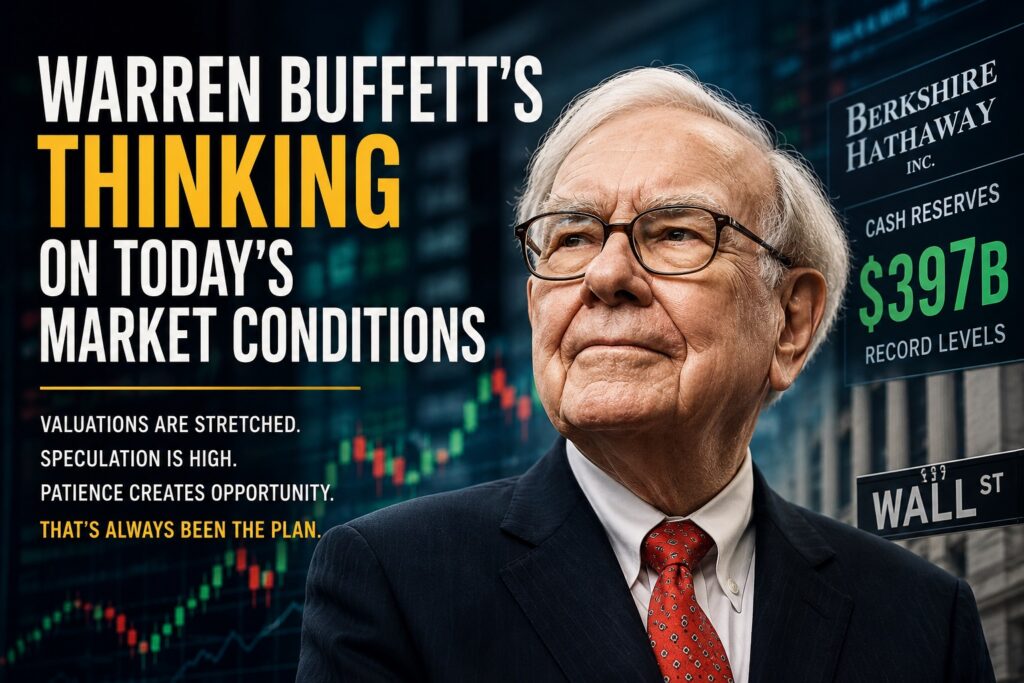 Warren Buffett’s View on Today’s Market Conditions - May 2026